
Urkupiña
VJ Set
Duration: 30 min.
Saturday, 04 May 2019 | 01:00 > 01:302019-05-05T01:00:00.000Z | Galleria VJ Sets
According to oral tradition, more than 300 years ago, the Virgin Mary chose a little shepherd for her first appearance in Quillacollo, Bolivia. While the girl was grazing sheep on the hill, she would have met a beautiful woman carrying a child in her arms. They say that she often talked with her in Quechua and that she even played with her little son (Jesus) in the water of a spring. "It's on the hill," the little shepherd said to explain the meeting to her parents. The phrase in Quechua means "Urkupiña", hence the name to venerate it.
For 33 years, the Bolivian community of the Villa el Libertador neighborhood in the city of Córdoba (Argentina) has celebrated the day of this Virgin, which they have called "Patron of Integration" since it brings together all the communities.
This congregation brings together Christians, lay people, Argentines, foreign, young and old people; the whole community. "She is a happy, festive Virgin" explain the attendees by the amount of colors and typical dances such as Tinkus, Caporales, Morenadas, Salay, etc.
Fortunately, the integration in these last years has been incorporating the LGBT and Queer community, which has a great relevance since being a purely religious commemoration, sexism and conservatism are still rooted. For example, in the Morenadas women were represented by men in disguise and just at the end of the 60's the female section of Cholitas was formed, wearing colorful and innovative designs. Nowadays it is no surprise to find trans, gays as well even women dressed in men's suits, dancing in the male ranks of caporales.
From an absolutely secular point of view, we filmed the 33rd Fiesta de la Virgen de Urkupiña (2018) but focusing on the devotion of the dancers and not on the figure of the saint. We work on two elements that are not common in the footage of this type of festivities: shots and time.
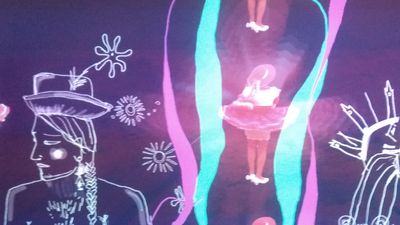
Through drawings (in real time) we accentuate the details to achieve a greater drama and work with the aesthetics loaded with colors and details that are typical of the costumes of these dance groups.
Our goal is to celebrate integration and diversity in all its forms.
For 33 years, the Bolivian community of the Villa el Libertador neighborhood in the city of Córdoba (Argentina) has celebrated the day of this Virgin, which they have called "Patron of Integration" since it brings together all the communities.
This congregation brings together Christians, lay people, Argentines, foreign, young and old people; the whole community. "She is a happy, festive Virgin" explain the attendees by the amount of colors and typical dances such as Tinkus, Caporales, Morenadas, Salay, etc.
Fortunately, the integration in these last years has been incorporating the LGBT and Queer community, which has a great relevance since being a purely religious commemoration, sexism and conservatism are still rooted. For example, in the Morenadas women were represented by men in disguise and just at the end of the 60's the female section of Cholitas was formed, wearing colorful and innovative designs. Nowadays it is no surprise to find trans, gays as well even women dressed in men's suits, dancing in the male ranks of caporales.
From an absolutely secular point of view, we filmed the 33rd Fiesta de la Virgen de Urkupiña (2018) but focusing on the devotion of the dancers and not on the figure of the saint. We work on two elements that are not common in the footage of this type of festivities: shots and time.
Through drawings (in real time) we accentuate the details to achieve a greater drama and work with the aesthetics loaded with colors and details that are typical of the costumes of these dance groups.
Our goal is to celebrate integration and diversity in all its forms.
Gallery
Urkupiña
Author
 Text is missing
 Text is missing
 Duo of light manipulator combining different disciplines on visual arts to create interventions in daily spaces.
Through videos and illustration they open imaginary gates where the spectator's glance is an indispensable element to re-discover scenes, and space-time.
Like stains and filaments we see floating in our field of vision, those gates can also be seen. So, are they real? Will they exist?
We can talk about something else.
Invitation is open.