1959
AV Installation
Duration: 0 min.
Thursday, 22 October 2026 | 15:00 > 15:002026-10-22T15:00:00.000Z | MAM Installations
Friday, 23 October 2026 | 15:00 > 15:002026-10-23T15:00:00.000Z | MAM Installations
Saturday, 24 October 2026 | 15:00 > 15:002026-10-24T15:00:00.000Z | MAM Installations
Sunday, 25 October 2026 | 15:00 > 15:002026-10-25T15:00:00.000Z | MAM Installations
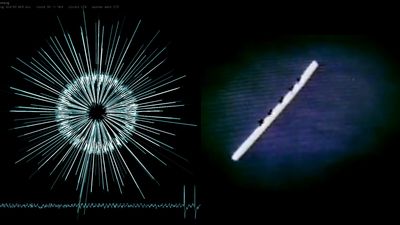
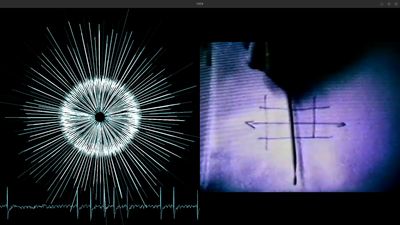
In 1959, David Hubel and Torsten Wiesel lowered an electrode into the visual cortex of a cat and moved a bar of light across its field of view. A single neuron answered, and its spikes were audible as clicks on tape. They received the 1981 Nobel Prize for what those clicks meant: that seeing is built, cell by cell, from single features of the world.
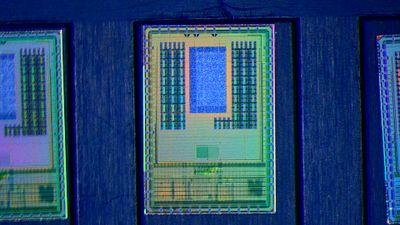
This installation plays that recording into a mixed-signal chip I designed and fabricated, containing sixteen analog spiking neurons. My neuron has a membrane, a leak and a threshold. It has no clock and computes no numbers: it answers in continuous time, in physics. It does not answer identically. No two neurons, born or made, ever do.
The visitor hears both: a cat's cortex from 1959 and silicon analog neuron from 2026 using state of the art microelectronic, in the same room, sixty-seven years apart, almost in unison. The chip is exposed on a plinth beside a print of the neuron and synapse layout.
Those same clicks are where machine vision began. Today's neural networks are a diagram of this cat. What they copied was the wiring. What they left behind was the body.
Sixteen neurons is not a brain. It is the start of a different bet: that machines which have to perceive, in real time, in the world, on the power the world can spare, should be made of physics rather than numbers. How far that goes, nobody knows yet. In 1959, nobody knew either.
This installation plays that recording into a mixed-signal chip I designed and fabricated, containing sixteen analog spiking neurons. My neuron has a membrane, a leak and a threshold. It has no clock and computes no numbers: it answers in continuous time, in physics. It does not answer identically. No two neurons, born or made, ever do.
The visitor hears both: a cat's cortex from 1959 and silicon analog neuron from 2026 using state of the art microelectronic, in the same room, sixty-seven years apart, almost in unison. The chip is exposed on a plinth beside a print of the neuron and synapse layout.
Those same clicks are where machine vision began. Today's neural networks are a diagram of this cat. What they copied was the wiring. What they left behind was the body.
Sixteen neurons is not a brain. It is the start of a different bet: that machines which have to perceive, in real time, in the world, on the power the world can spare, should be made of physics rather than numbers. How far that goes, nobody knows yet. In 1959, nobody knew either.
Gallery
1959
Videos
1959
Author
 I am a professor in the Electrical Engineering Department of the Eindhoven University of Technology (TU/e), leading the Neuromorphic Edge Computing Systems (NECS) Lab.
My interest lies in the field of neural networks, artificial intelligence, and neurobiological systems. My research is devoted to the development of bio-inspired unconventional computing machines comprising sensory systems and information processing devices based on bio-inspired neural networks.